AI & LLM | Personal | 3 min read
OCR Digit Prediction.
No TensorFlow, no PyTorch, just NumPy and backprop written by hand. A two-layer neural network that recognizes the digit you draw, live, in the browser. 84.4% accuracy, and above all the certainty of knowing what happens inside.
- 84.4% accuracy
- Zero ML framework
OCR Digit Prediction
Personal project : an optical character recognition system for digits (0-9) built on an artificial neural network (ANN), using a client-server architecture.
Preview
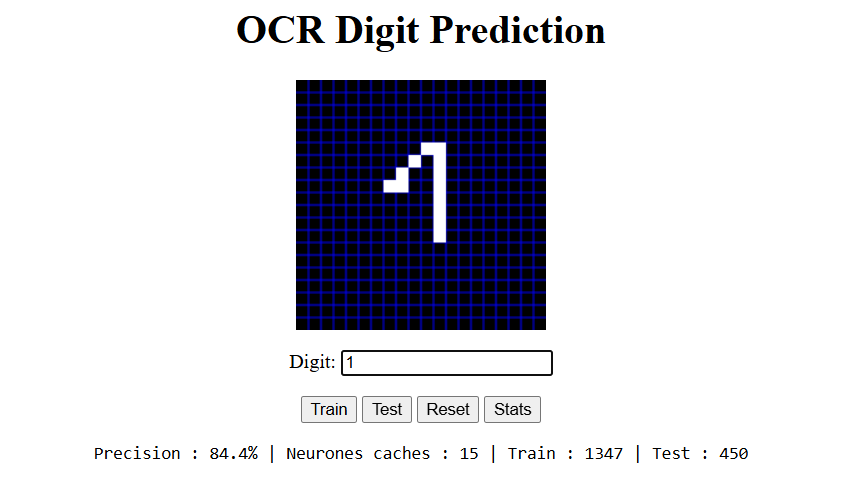
Drawing interface with a 20x20 pixel canvas and real-time metrics display.
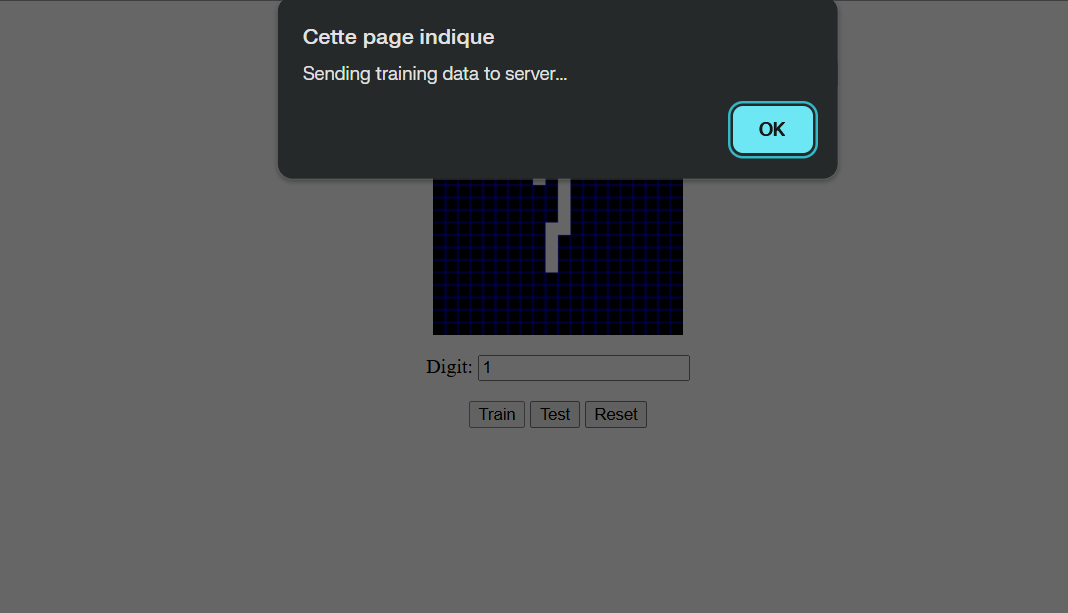
Sending training data to the server.
Architecture
The project consists of three Python files and a web frontend :
-
ocr.py: defines theOCRNeuralNetworkclass, which implements a two-layer neural network (one hidden layer, one output layer). It handles weight initialization, backpropagation training, prediction, and weight persistence innn.json. -
server.py: starts an HTTP server onlocalhost:8000. It loads the handwritten digit dataset, trains the network on startup (or loads existing weights), and exposes two POST endpoints : one for training from the browser, one for predicting a drawn digit. -
neural_network_design.py: contains atest()utility function to evaluate network accuracy on a validation set, averaged over 100 passes.
How it works
- The user draws a digit on the HTML canvas (20x20 pixels).
- The frontend sends the image to the server as an array of 400 float values (between 0 and 1).
- The server passes the image through the neural network and returns the predicted digit (0-9).
- The user can also correct a wrong prediction : the frontend sends the data back with the correct label to retrain the network in real time.
Neural network
The network uses a simple feedforward architecture :
- Input layer : 400 neurons (one per pixel)
- Hidden layer : 15 neurons (configurable)
- Output layer : 10 neurons (one per digit 0-9)
The activation function is the sigmoid. Training uses gradient descent with a learning rate of 0.1.
Results and observations
Metrics obtained on the sklearn digits dataset (1797 images total) :
| Metric | Value |
|---|---|
| Accuracy | 84.4% |
| Hidden nodes | 15 |
| Training set | 1347 images (75%) |
| Test set | 450 images (25%) |
Interpretation :
- 84.4% is reasonable for such a simple network trained without a framework and on limited data. It means roughly 1 digit in 6 is misclassified.
- Accuracy is averaged over 100 passes to smooth out variations due to random weight initialization.
- The network performs better on well-formed, centered digits. Unusual handwriting styles or off-center drawings are more often misclassified.
- The sklearn digits dataset contains 8x8 images resized to 20x20, which introduces a slight quality loss compared to data drawn directly by hand.
Optimization ideas
- Increase hidden nodes : going from 15 to 25-30 would improve the model's ability to represent complex patterns, at the cost of longer training.
- Use a better dataset : replacing sklearn digits (8x8) with MNIST (28x28, 70,000 images) would bring more diversity and better generalization.
- Use an adaptive learning rate : the fixed 0.1 rate can be too high or too low depending on the training stage. An optimizer like Adam adjusts this automatically.
- Add more hidden layers : a single hidden layer limits the network's capacity to learn abstract representations. Two layers often improve performance.
- Normalize input data : pixel values are not always in the same range depending on how the user draws. Strict normalization stabilizes training.
- Add data augmentation : generating slightly shifted, rotated, or thickened variants of drawn images would help the network handle different writing styles.
Main limitation : the current architecture (dense ANN) does not account for the spatial structure of the image. A convolutional network (CNN) would be far better suited for handwritten digit recognition and would easily reach 98-99% accuracy on MNIST.
Getting started
python server.py
The server starts on http://localhost:8000. Then open the HTML frontend in a browser.
Dependencies
- Python 3
- numpy
- scikit-learn